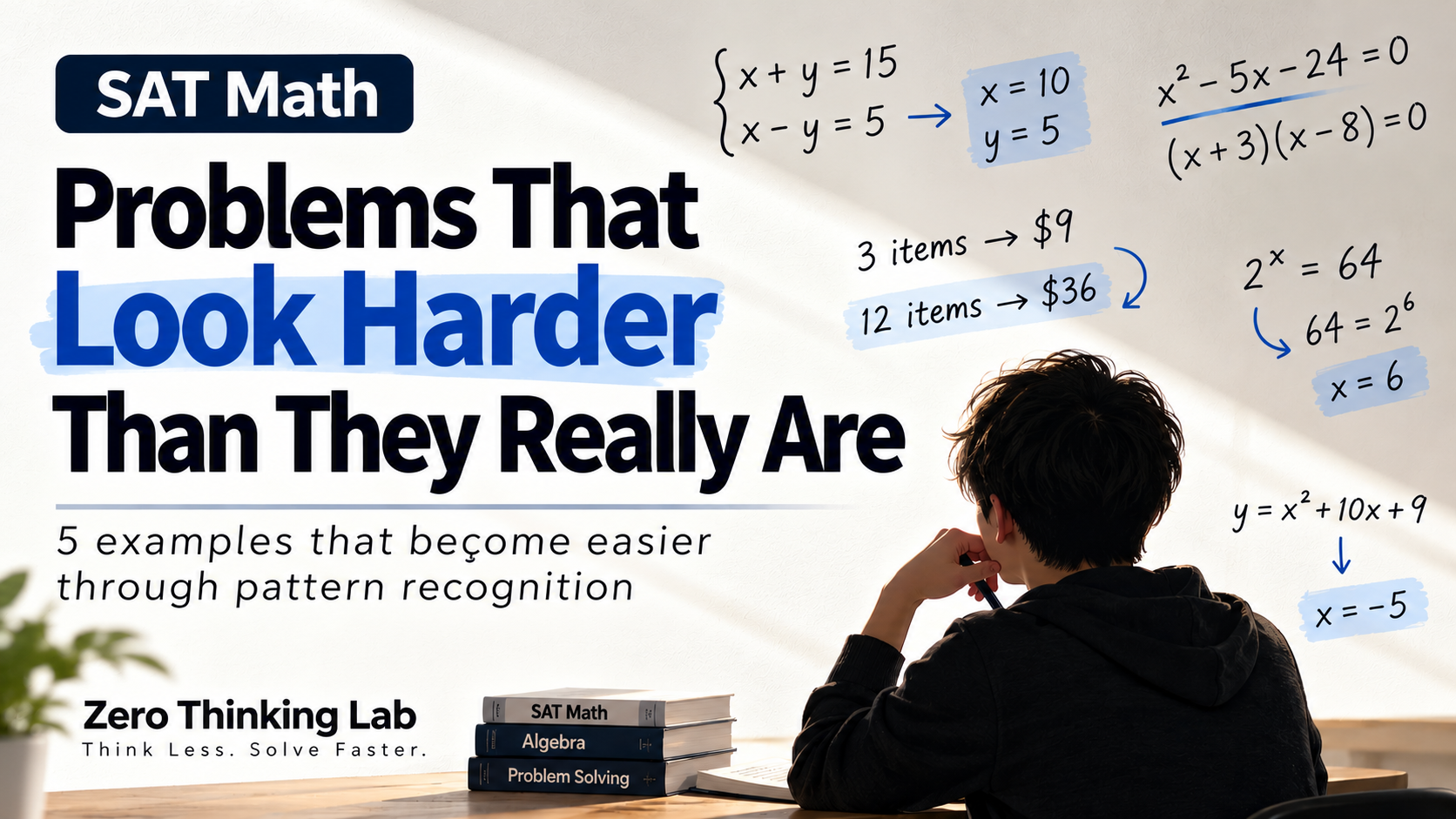
I solved a few SAT-style math problems today, and none of them were really about “doing a lot of math.”
Most of them got easier once the pattern showed up.
1. System of Equations
(x + y = 15)
(x – y = 5)
This one barely felt like algebra.
If the total is 15 and the difference is 5, then 10 and 5 show up pretty quickly in your head.
You can add the equations together.
But honestly, the numbers already feel obvious before that.
That’s usually a good sign in SAT math.
2. Factoring
(x² – 5x – 24 = 0)
I factored it into:
((x + 3)(x – 8) = 0)
One habit I’ve started using:
I always write the smaller x-intercept first.
So instead of:
((x – 8)(x + 3))
I write:
((x + 3)(x – 8))
It sounds tiny, but later when thinking about graphs or sign charts, it keeps things cleaner in my head.
Less mental friction.
3. Ratios
3 items cost 9 dollars.
How much for 12 items?
I didn’t really think about proportions here.
I just saw:
3 → 9
Then multiplied both by 4.
12 → 36
That felt lighter than building an equation first.
4. Exponents
(2ˣ = 64)
This one disappears instantly if you already know:
(64 = 2⁶)
A lot of SAT math feels this way.
Recognition saves more time than calculation.
5. Quadratic Functions
(y = x² + 10x + 9)
The vertex x-value shows up almost immediately:
(x = -5)
No need to complete the square if the structure is already familiar.
That’s probably the biggest thing I’m noticing lately.
SAT math gets much easier once you stop treating every problem like a full calculation problem.
Sometimes the answer is already halfway visible before you start solving.
Think Less. Solve Faster.
コメント