I worked through a simple multiplication problem today.
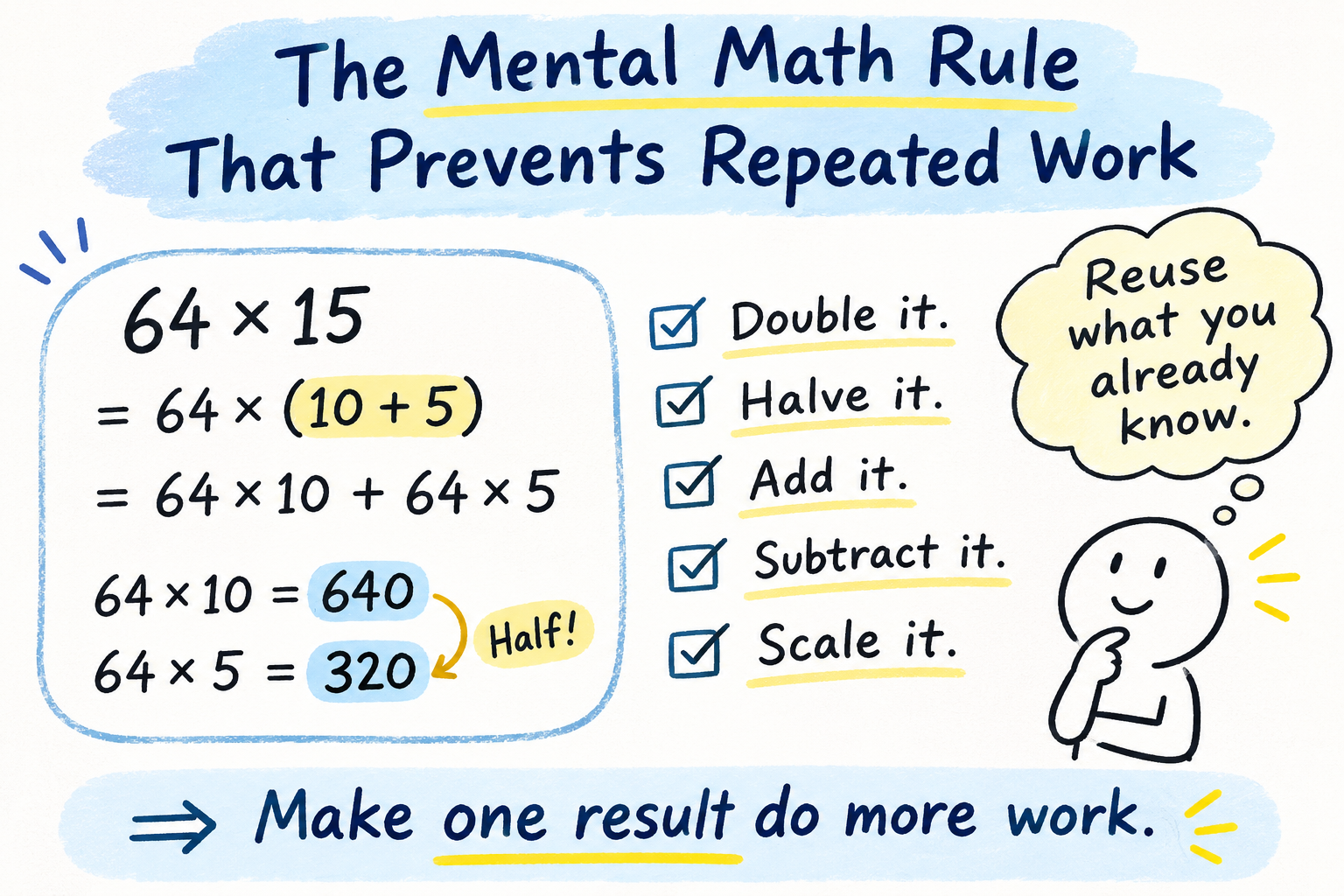
64 × 15
The answer came quickly, but what interested me wasn’t the answer.
It was the way I got there.
The first thing I noticed was that 15 could be broken into 10 and 5.
So I rewrote the problem mentally:
64 × 15
=
64 × 10 + 64 × 5
At first glance, that doesn’t seem special.
But then I realized something.
I never actually calculated 64 × 5.
I calculated 64 × 10.
Then I took half.
That’s all.
Once I knew that:
64 × 10 = 640
The second piece was already available.
64 × 5 = 320
No new calculation was needed.
I simply reused the result I already had.
I’ve started noticing that I do this often.
When a problem gives me something useful, I try to keep using it.
I don’t like solving the same thing twice.
If I already know a value, I look for ways to build from it.
Double it.
Halve it.
Add it.
Subtract it.
Scale it.
Anything except starting over.
The goal isn’t to be clever.
The goal is to avoid unnecessary work.
A lot of mental math feels faster because of this.
Not because I’m calculating more quickly.
Because I’m calculating less often.
Once a useful number appears, I try to make it do as much work as possible.
The answer often arrives sooner than expected.
Think Less. Solve Faster.
コメント