I worked through another set of SAT-style math problems today.
As I looked back at my solutions, I noticed a pattern.
Many of the problems became easier once I translated the numbers into a form I liked better.
The first example was simple.
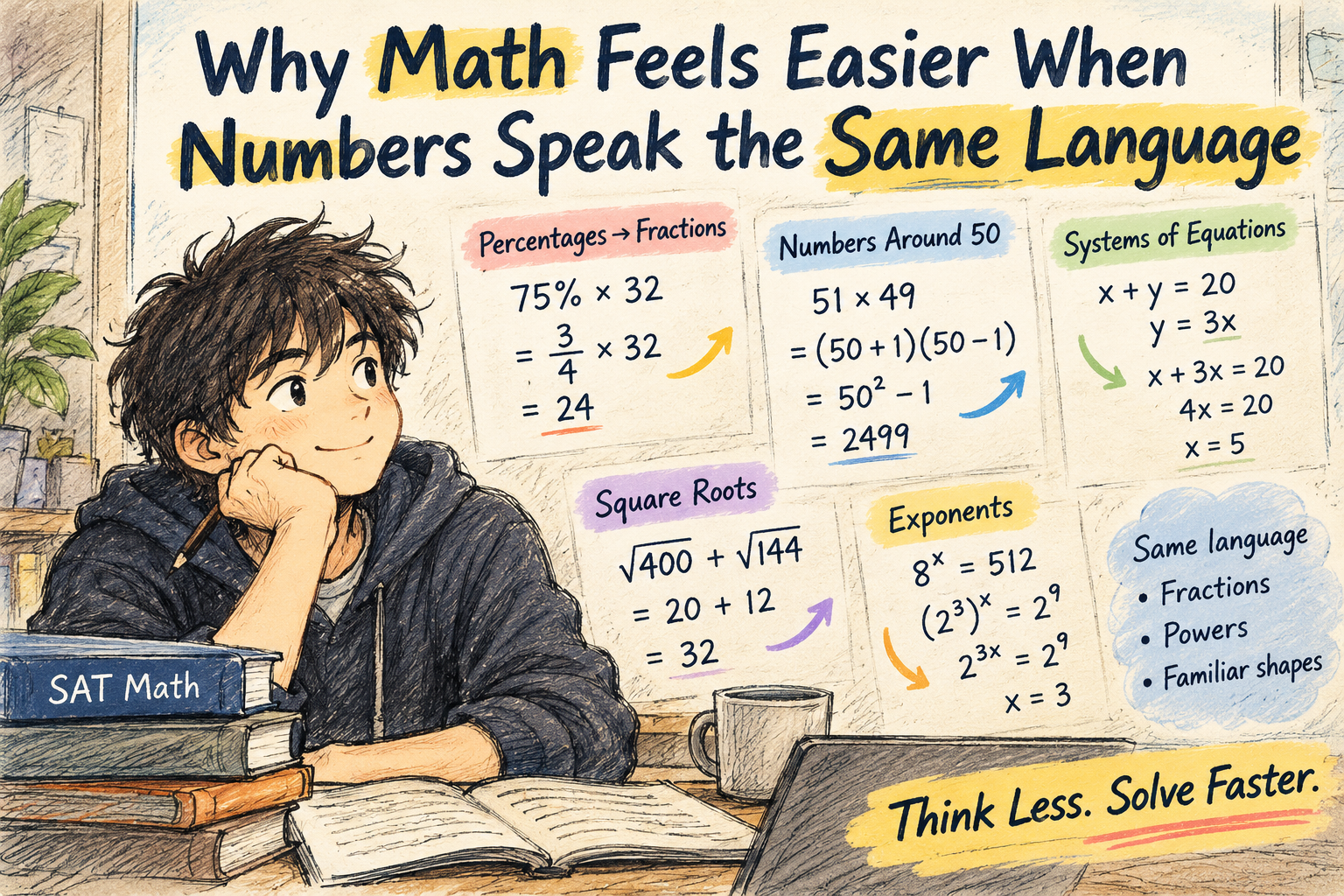
75% × 32
I didn’t really think about decimals.
Instead, I saw 75% as 3/4.
Once I did that, the problem felt familiar.
Divide 32 by 4.
Multiply by 3.
Done.
The percentage disappeared and became a fraction.
A language I trust more.
The same thing happened with 51 × 49.
I didn’t see two separate numbers.
I saw numbers surrounding 50.
That immediately reminded me of a familiar pattern:
(50 + 1)(50 – 1)
The problem stopped being multiplication and became a difference of squares.
Again, a translation.
The equation problem was straightforward.
x + y = 20
y = 3x
Substitution solved it immediately.
There wasn’t much thinking involved because the structure was already familiar.
The square root problem felt even lighter.
√400 + √144
I don’t calculate those.
I recognize them.
400 is 20².
144 is 12².
The roots disappear before the problem really begins.
The exponent problem was my favorite.
8ˣ = 512
I didn’t try random values for x.
Instead, I moved everything into the same world.
I know that 512 is 2⁹.
I know that 8 is 2³.
Once both sides were speaking the language of powers of 2, the answer became obvious.
That’s something I’ve started noticing more often.
Many SAT Math problems become easier when everything speaks the same language.
Percentages become fractions.
Large numbers become powers.
Expressions become familiar shapes.
The goal isn’t to calculate faster.
The goal is to make the problem easier to understand.
Once everything lives in the same world, the answer often feels much closer.
Think Less. Solve Faster.

コメント