I worked through another set of SAT-style math problems today.
As I looked back at them, I noticed something.
I rarely work with numbers exactly as they appear.
My first instinct is usually to translate them into something more familiar.
The percentage problem was a good example.
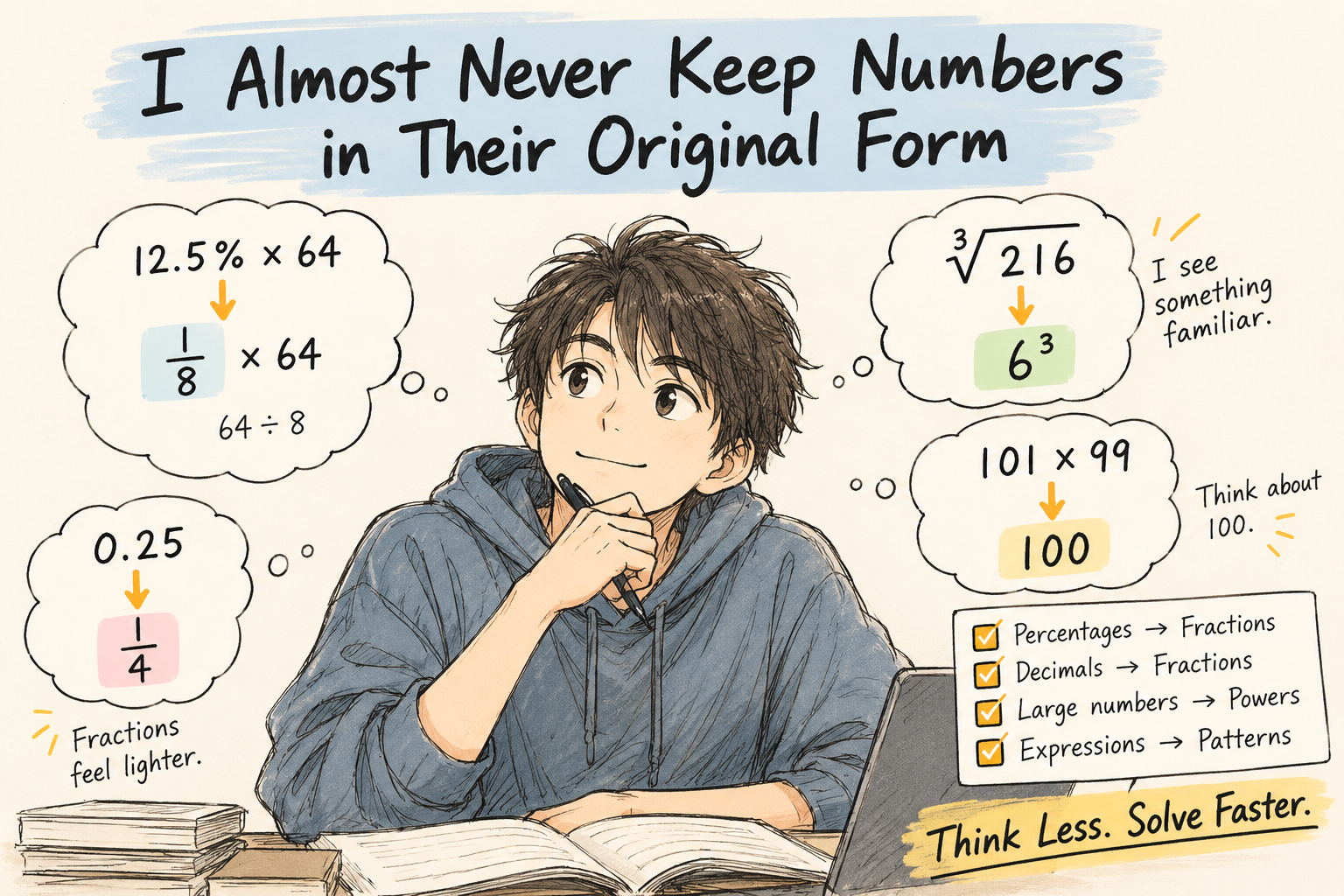
12.5% × 64
I didn’t think about decimals.
I didn’t think about percentages.
The moment I saw 12.5%, I saw 1/8.
At that point, the problem became simple.
64 divided by 8.
The original form disappeared.
A similar thing happened with 0.25.
I don’t really see 0.25 anymore.
I see 1/4.
Fractions feel lighter to me.
They’re easier to manipulate mentally.
The cube root problem felt familiar too.
When I saw 216, I didn’t see a random number.
I saw 6³.
The answer appeared almost immediately because the number already belonged to something I knew.
The same thing happened with 101 × 99.
I wasn’t thinking about multiplication.
I was thinking about 100.
The numbers felt connected to something familiar.
That’s something I’ve started noticing more often.
Many SAT Math problems become easier once I stop looking at the numbers exactly as they’re written.
Percentages become fractions.
Decimals become fractions.
Large numbers become powers.
Expressions become patterns.
The goal isn’t to calculate faster.
The goal is to see something more useful.
Once the translation happens, the problem often feels much smaller.
Think Less. Solve Faster.
コメント