I solved another set of SAT-style math problems today.
Something interesting stood out.
I wasn’t really calculating.
Most of the time, I was making a guess and checking whether it fit.
That sounds risky, but it often feels faster than building everything from scratch.
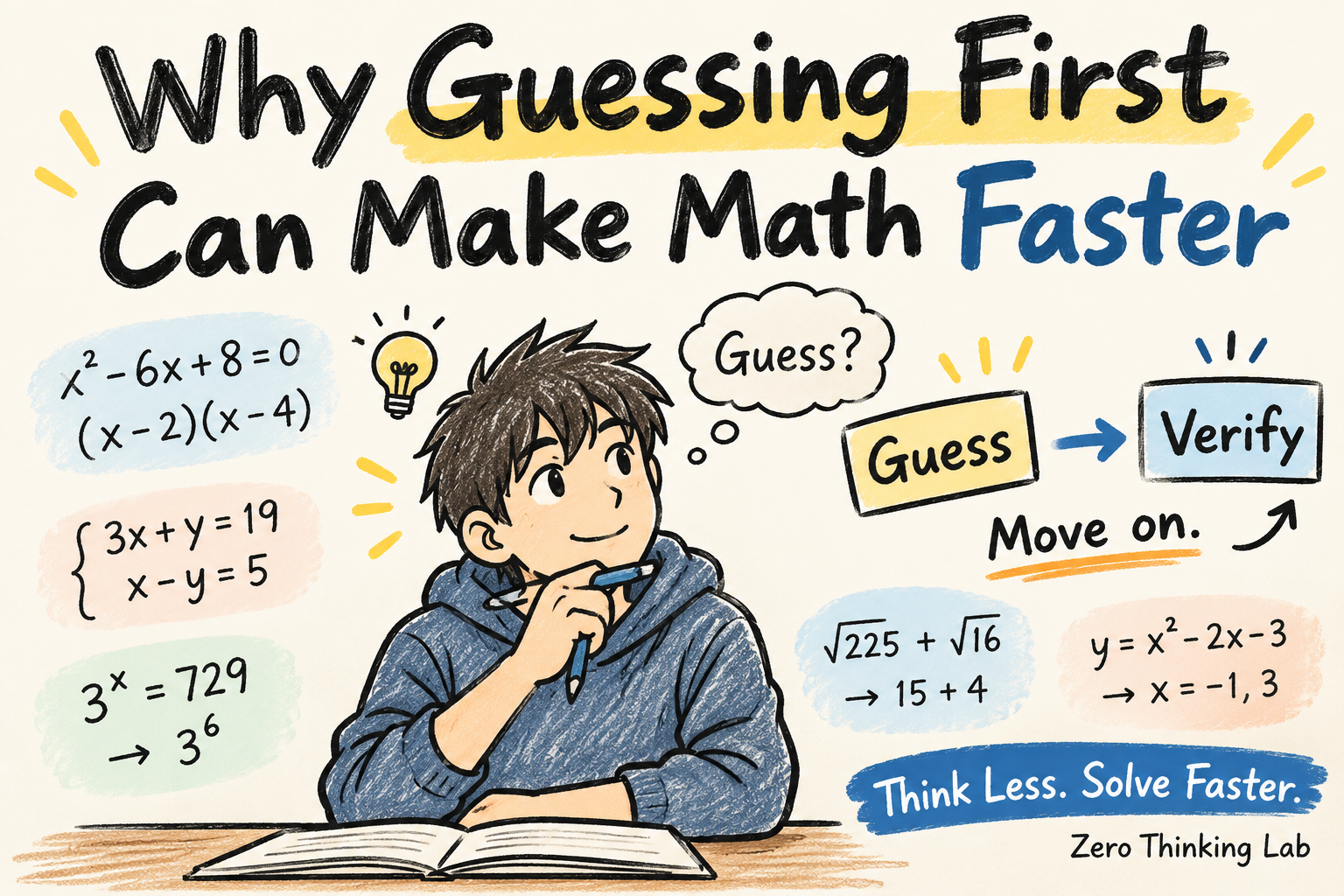
Factoring
x² – 6x + 8 = 0
The number 8 doesn’t have many factor pairs.
2 and 4 appear immediately.
The moment they add up to 6, the problem is finished.
I never feel like I’m searching very hard.
The possibilities are simply limited.
Systems of Equations
3x + y = 19
x – y = 5
The opposite signs on y stand out instantly.
I don’t compare different methods anymore.
I already know what’s going to happen.
The y terms disappear.
The path is obvious.
Exponents
3ˣ = 729
This one was interesting.
I didn’t start with powers of 3.
I noticed that 729 looked divisible by 9.
Then I saw 81.
Suddenly the number became:
9 × 81
or
3² × 3⁴
which is simply 3⁶.
The answer appeared after breaking the number into familiar pieces.
Square Roots
√225 + √16
When I saw 225, I didn’t calculate.
I guessed.
15² felt right.
Then I checked it.
15 × 15 = 225.
Done.
I do this a lot.
Instead of calculating toward an answer, I often move from a likely answer toward confirmation.
X-Intercepts
y = x² – 2x – 3
Again, there aren’t many possibilities.
Once +1 and -3 appear, the intercepts appear too.
The structure reveals itself quickly.
A Different Kind of Speed
I used to think fast math meant fast calculation.
Now I’m starting to think it’s something else.
Often the fastest approach is:
Guess.
Verify.
Move on.
Not random guessing.
Educated guessing.
Pattern-based guessing.
The more familiar the patterns become, the more useful this approach feels.
Think Less. Solve Faster.
コメント