I solved another small set of SAT-style math problems today.
What’s interesting is that I don’t feel faster.
It feels more like there are fewer choices.
A while ago, I would look at a problem and think:
“What method should I use?”
Now that question shows up less and less.
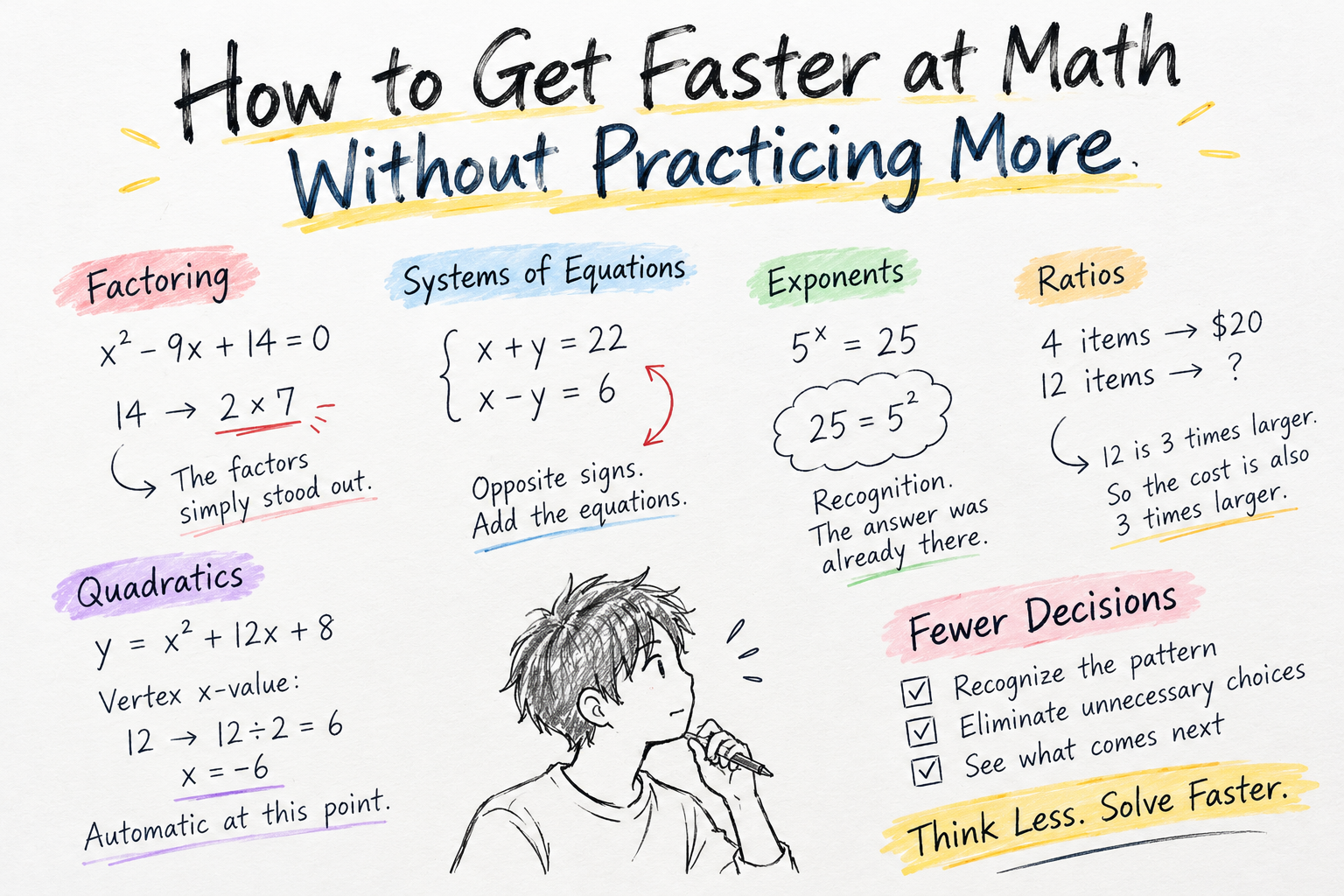
Factoring
x² – 9x + 14 = 0
When I saw 14, there weren’t many possibilities.
2 and 7 appeared almost immediately.
I didn’t really choose a strategy.
The factors simply stood out.
Systems of Equations
x + y = 22
x – y = 6
The opposite signs on y were obvious.
I knew I was adding the equations before I even thought about other methods.
The decision was already made.
Exponents
5^x = 25
This wasn’t a problem.
It was recognition.
25 already belongs to the family of powers of 5.
The answer was sitting there waiting to be noticed.
Ratios
4 items cost $20.
12 items cost ?
I never thought about setting up a proportion.
I only saw that 12 is three times larger than 4.
So the cost should also be three times larger.
That’s all.
Quadratics
y = x² + 12x + 8
At this point, the vertex x-value feels automatic.
I see 12.
I divide by 2.
I make it negative.
x = -6.
Done.
Fewer Decisions
I think that’s the biggest difference I’m noticing lately.
Getting faster at math doesn’t always mean calculating faster.
Sometimes it means eliminating decisions.
You stop asking yourself what to do.
You simply recognize what comes next.
And once that happens, the problems start feeling surprisingly light.
Think Less. Solve Faster.

コメント