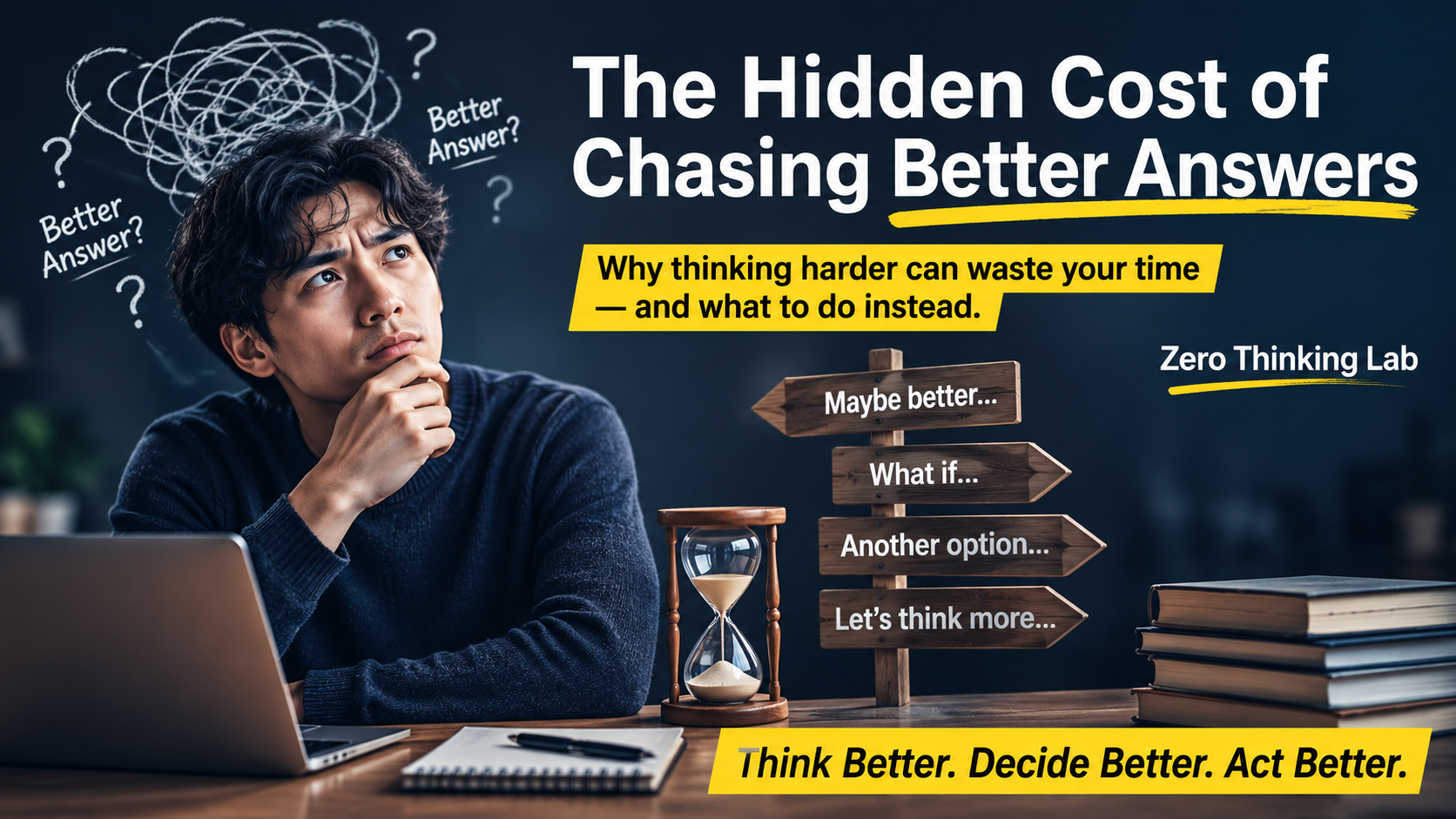
Most people believe better decisions come from thinking longer.
But what if the opposite is true?
What if the best decision isn’t the one you spent the most time on, but the one you reached after removing unnecessary thinking?
Every day, we make hundreds of decisions.
Some are small.
Some shape the direction of our lives.
We choose what to study.
What to buy.
How to solve a problem.
When to stop searching.
When to move forward.
Most people assume that better decisions require more thinking.
It sounds reasonable.
If thinking helps, then more thinking should help even more.
But experience tells a different story.
Have you ever spent thirty minutes comparing two products, only to realize either one would have been perfectly fine?
Have you ever rewritten the same email five times without making it meaningfully better?
Have you ever searched for a “better” solution when a good solution was already sitting in front of you?
If so, you have experienced something that rarely gets discussed:
The cost of chasing better answers.
Thinking Is an Investment
Most people think of money as an investment.
Some think of time as an investment.
Very few think of thinking as an investment.
But they should.
Every minute you spend thinking is a minute you cannot spend acting.
Every decision consumes something valuable:
- Time
- Attention
- Mental energy
These resources are limited.
Once they are spent, they cannot be recovered.
This doesn’t mean thinking is bad.
Quite the opposite.
Thinking is one of the highest-return investments we can make.
The real question is different:
Are you investing your thinking where it creates the greatest value?
That single question changed the way I look at problem solving.
And eventually, it became the foundation of Zero Thinking.
The Problem Isn’t Thinking
Let’s make one thing clear.
Zero Thinking is not about thinking less.
It is not about making rushed decisions.
It is not about accepting mediocre answers.
It is not about shortcuts.
The goal is simple:
Remove thinking that creates little value, so you can spend more of your thinking on what truly matters.
Imagine you have one hundred units of attention every day.
Where should you invest them?
On endlessly improving a decision that is already good enough?
Or on making your next important decision better?
The answer seems obvious.
Yet most of us unconsciously choose the first.
Not because it creates more value.
Because it feels safer.
The Illusion of Progress
One of the most dangerous traps in decision-making is confusing more thinking with better thinking.
The two are not the same.
Sometimes, another hour of thinking dramatically improves your decision.
Sometimes, another hour changes almost nothing.
Learning to recognize the difference is a skill.
Fast decision-makers are not fast because they avoid thinking.
They are fast because they recognize the moment when additional thinking no longer creates meaningful value.
They stop investing in low-return thinking.
And redirect that investment somewhere more valuable.
That is the beginning of better decisions.
Think Less. Solve Faster.

コメント