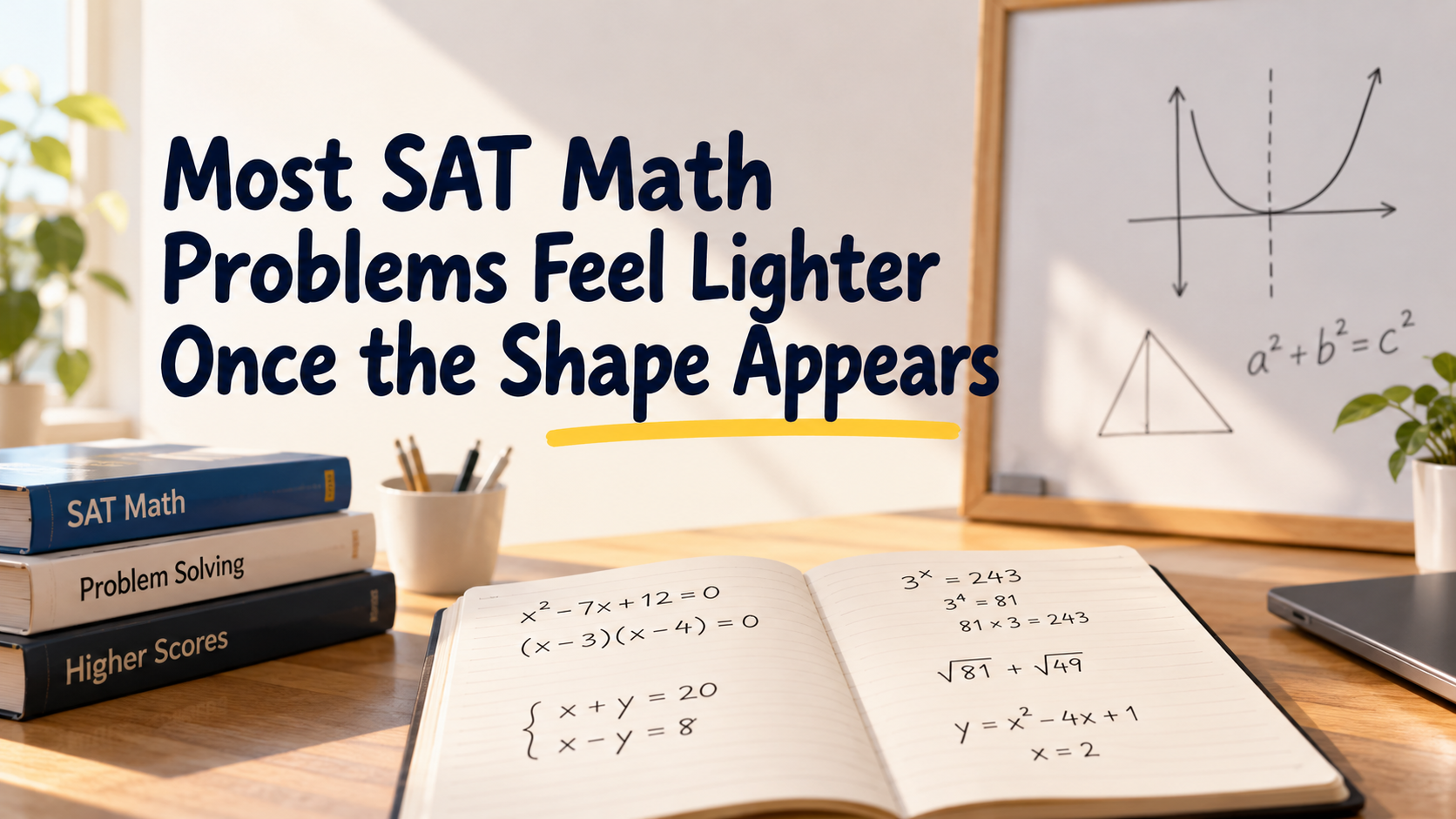
I solved five more SAT-style math problems today.
What stood out again wasn’t calculation speed.
It was how much easier the problems became once the structure showed up.
1. Factoring Is Mostly Pattern Recognition
x² − 7x + 12 = 0
The numbers were small, and the signs were different.
So it immediately felt like the factors would probably be close together.
3 and 4 showed up pretty naturally.
(x − 3)(x − 4) = 0
No long thinking process there.
Just recognition.
2. Some Systems Are Designed to Collapse Instantly
x + y = 20
x − y = 8
This one disappears the moment you add the equations.
The y terms cancel immediately.
A lot of SAT problems are built like this.
They look longer than they really are.
3. Exponents Feel Easier When You Start From Something Familiar
3ˣ = 243
I didn’t directly “know” 243 immediately.
But I instantly recognized:
3⁴ = 81
From there, checking one more multiplication is easy.
81 × 3 = 243
So x = 5.
Sometimes recognizing part of the pattern is enough.
You don’t always need the entire answer instantly.
4. Square Roots Should Feel Automatic
√81 + √49
This honestly feels closer to memorization than math.
9 and 7 come out immediately.
If basic square roots still require active thinking, SAT timing gets heavy very quickly.
Some things are better stored than solved.
5. Quadratics Start Looking Visual After a While
y = x² − 4x + 1
The vertex x-value appeared almost instantly.
x = 2
At this point, some quadratic structures stop feeling like equations and start feeling visual.
You don’t fully calculate them anymore.
You recognize them.
That’s probably the biggest thing I keep noticing with SAT math.
The problems usually become lighter before they become solved.
Think Less. Solve Faster.
コメント