I solved another set of SAT-style math problems today.
Something stood out while I was working through them.
When I look at a problem, my first instinct usually isn’t to solve it.
It’s to simplify it.
More specifically, I try to make the numbers smaller.
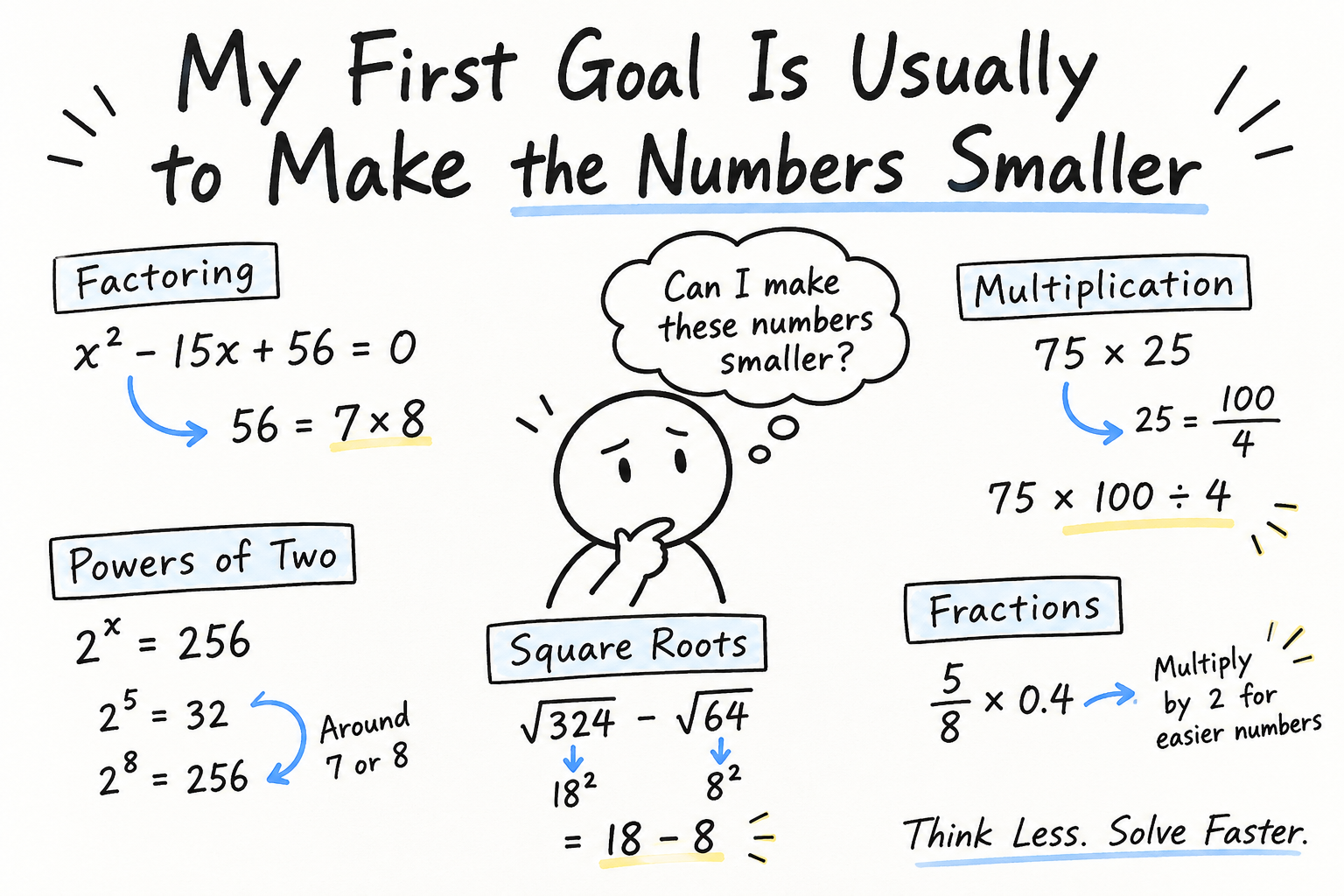
Factoring
x² – 15x + 56 = 0
The moment I saw 56, I thought of 7 and 8.
Not because I was running a factoring procedure.
The numbers simply looked familiar.
When the factors are small and recognizable, the problem feels light immediately.
Powers of Two
2ˣ = 256
I didn’t know the answer instantly.
I started from something I already knew:
2⁵ = 32
That told me the answer was probably somewhere around 7 or 8.
A quick check confirmed that:
2⁸ = 256.
I wasn’t calculating from the beginning.
I was navigating from a known landmark.
Square Roots
√324 − √64
Whenever I see square roots, my first goal is simple:
Can I turn these into ordinary numbers?
324 became 18².
64 became 8².
Once the roots disappeared, the problem became trivial.
Multiplication
75 × 25
Instead of multiplying directly, I rewrote 25 as 100/4.
Now the problem became:
75 × 100 ÷ 4
The numbers felt easier immediately.
I do this all the time.
I’m not looking for a clever trick.
I’m looking for a friendlier version of the problem.
Fractions
5/8 × 0.4
I could have converted everything into fractions first.
Instead, I noticed that multiplying by 2 would create smaller numbers after cancellation.
The goal wasn’t elegance.
The goal was simplicity.
Smaller numbers are easier to trust.
What Fast Math Feels Like
People often imagine fast math as doing calculations quickly.
That’s not what it feels like to me.
Most of the time, I’m trying to transform the problem into something easier.
Smaller numbers.
Friendlier numbers.
More familiar numbers.
Once that happens, the answer often takes care of itself.
Think Less. Solve Faster.
コメント