I worked through another set of SAT-style math problems today.
Looking back, something interesting happened.
I wasn’t really solving the problems.
I was removing parts of them.
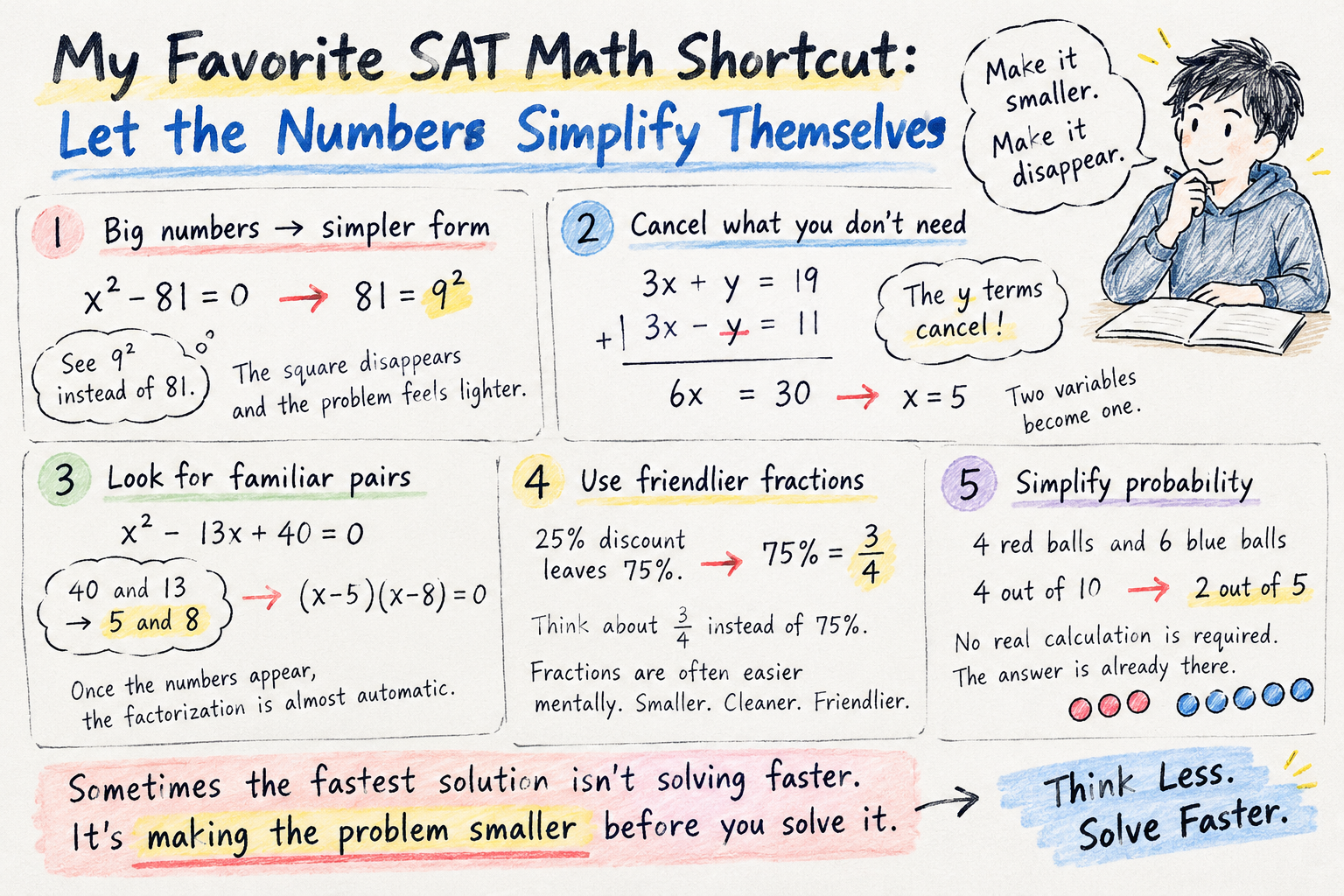
The first example appeared immediately.
x² – 81 = 0
The moment I saw 81, I didn’t see a number.
I saw 9².
Once that happened, the equation stopped looking complicated.
The square disappeared.
The problem immediately felt lighter.
The same thing happened with a system of equations.
3x + y = 19
3x – y = 11
I wasn’t thinking about substitution.
I noticed that the y terms wanted to cancel.
Adding the equations made them disappear instantly.
Instead of dealing with two variables, I only had one.
The problem became easier before I even started solving it.
Factoring felt similar.
x² – 13x + 40 = 0
I wasn’t running through a factoring checklist.
I was looking for a familiar pair.
40 and 13 eventually pointed me toward 5 and 8.
Once those numbers appeared, the factorization was almost automatic.
The percentage problem followed the same pattern.
A 25% discount leaves 75% of the original price.
But I didn’t really think about 75%.
I thought about 3/4.
Fractions often feel easier to work with mentally.
Smaller.
Cleaner.
Friendlier.
The probability question might have been the simplest example.
There were 4 red balls and 6 blue balls.
I immediately saw 4 out of 10.
Then I saw 2 out of 5.
No real calculation was required.
The answer was already sitting there.
People often think fast math is about calculating quickly.
That isn’t what it feels like to me.
Most of the time, I’m looking for something that can disappear.
A variable.
A percentage.
A large number.
An unnecessary step.
The less I have to carry in my head, the lighter the problem becomes.
Sometimes the fastest solution isn’t solving faster.
It’s making the problem smaller before you solve it.
Other times, it’s making parts of the problem disappear entirely.
Think Less. Solve Faster.
コメント