Today I worked through another set of SAT-style math problems.
The interesting part wasn’t the answers.
It was the order in which things appeared in my head.
When I was younger, I assumed strong math students followed a method and arrived at an answer.
Lately, I’ve noticed that my brain often does the opposite.
Sometimes I see the answer first.
Then I figure out why it’s correct.
Factoring Doesn’t Feel Like a Process Anymore
One of today’s problems was:
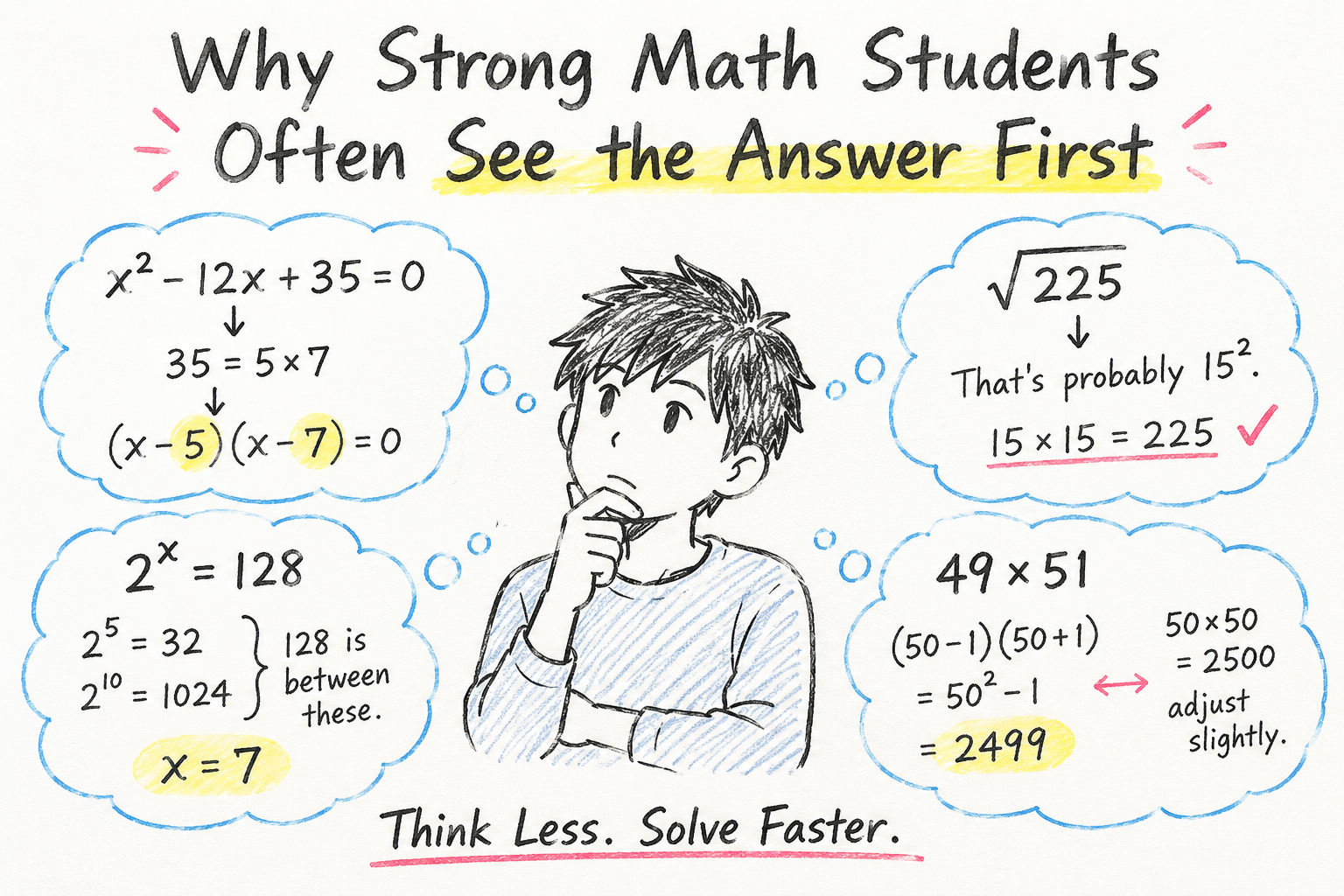
x² – 12x + 35 = 0
I wasn’t thinking about factoring formulas.
I saw 35.
Then I saw 5 and 7.
The answer appeared before I consciously thought about a method.
After that, writing the factors was just bookkeeping.
The work felt finished before the pencil moved.
Familiar Numbers Create Shortcuts
Another problem asked:
2ˣ = 128
I didn’t build the answer from scratch.
I already know:
2⁵ = 32
2¹⁰ = 1024
128 lives somewhere between those numbers.
Once I placed it in that neighborhood, the answer became obvious.
I wasn’t calculating.
I was locating.
Estimation Comes Before Verification
The most interesting example was:
√225
I didn’t start multiplying numbers.
My first thought was:
“That’s probably 15².”
Why?
Because the number ends in 5.
Because 20² is 400.
Because 225 feels comfortably below that range.
The answer showed up as an estimate first.
Then I checked it.
15 × 15 = 225.
Correct.
A lot of people think fast problem solvers avoid checking their work.
I’ve noticed the opposite.
The better I get, the more often I verify.
The difference is that verification becomes cheap.
Two Answers Arriving at the Same Time
My favorite problem today was:
49 × 51
One thought was:
50 × 50 = 2500
Then adjust slightly.
At almost the same time, another idea appeared:
(50 − 1)(50 + 1)
Which becomes:
50² − 1
= 2499
I wasn’t consciously choosing between methods.
Both patterns appeared naturally.
And when both approaches point to the same answer, confidence increases immediately.
What Fast Math Actually Feels Like
People often imagine fast math as rapid calculation.
That isn’t what it feels like to me anymore.
More often, it feels like recognition.
I see a familiar shape.
A familiar pattern.
A familiar neighborhood.
The answer starts to appear before a formal method does.
Then the method becomes a way to confirm what I already suspect.
That’s probably the biggest lesson I’ve learned recently.
Strong math isn’t always about calculating faster.
Sometimes it’s about recognizing sooner.
Think Less. Solve Faster.
コメント