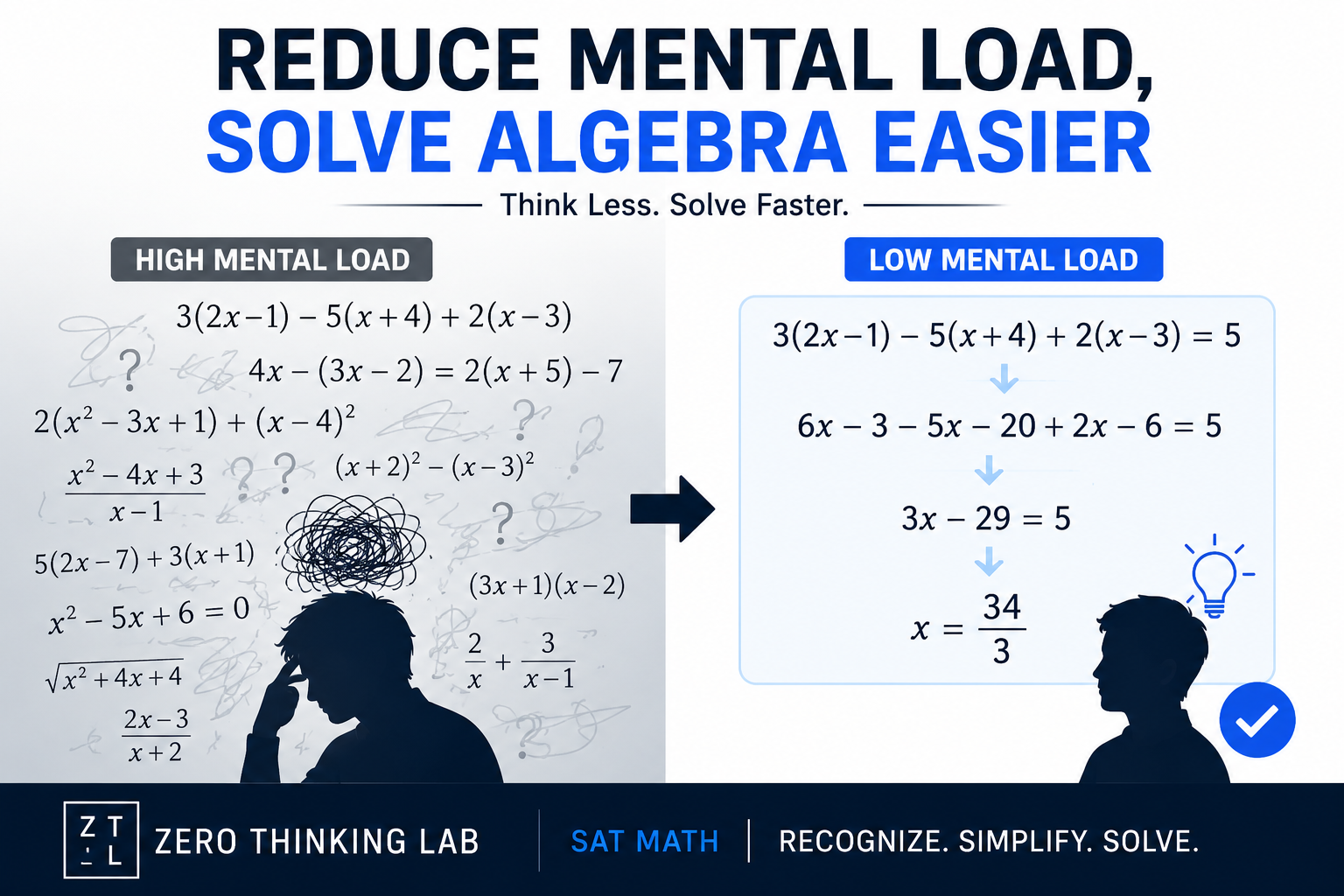
Most students think fast algebra means calculating quickly.
But when I solve equations fast, I’m usually not calculating more.
I’m calculating less.
The biggest difference between fast students and slow students is not intelligence.
It’s mental processing.
Fast students constantly reduce unnecessary thinking.
They simplify structure early, avoid large numbers, and remove unnecessary writing.
That’s what creates speed.
Problem 1

The moment I see this equation, I already notice:
4x + 5 = 29
That immediately becomes the structure I’m aiming for.
I’m not thinking about “moving terms.”
I’m thinking:
“How fast can I make the coefficient of become 1?”
So mentally, I already see:
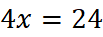
and then:
x = 6
Most students write many intermediate steps because they process the equation one action at a time.
But once you recognize the structure early, a lot of writing becomes unnecessary.
Problem 2

Most students immediately expand the left side:

But I never even want to create that equation.
The moment I see the problem, I notice that every term is divisible by 2.
That means I can simplify the equation before expanding anything.
So mentally, the equation becomes:

Now the structure is much lighter.
The numbers are smaller.
The coefficients are easier to process.
The equation becomes visually cleaner.
Fast algebra is often about preventing complexity before it appears.
Problem 3
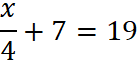
A lot of students multiply everything by 4 immediately.
That creates:
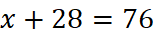
But I try to avoid creating large numbers too early.
Large numbers increase mental load.
They create more opportunities for mistakes and require more processing.
So instead, I simplify the structure first:

Only after the equation becomes simple do I multiply by 4:

The goal is not just solving the equation.
The goal is keeping the equation mentally lightweight.
Problem 4

As soon as I distribute the left side mentally, I already see:
10x − 15 = 4x + 21
That means the equation is basically finished structurally.
At that point, I only need to process the constants.
Many students think fast algebra means writing faster.
But most of the speed actually comes from recognizing the final structure early.
Once I know the equation will become:
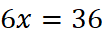
everything else feels automatic.
Problem 5

Again, I’m not focusing on writing every step perfectly.
I immediately look at the coefficient of .
The moment I distribute mentally, I already know the equation becomes:
5x − 15 = 20
That means the structure is simple.
Then I only calculate the constants and divide at the end.
x = 7
Fast students are often simplifying the problem mentally long before they finish writing.
What Fast Students Actually Do
Fast students are usually not “doing more math.”
They are removing unnecessary processing.
They constantly try to:
- reduce the number of steps
- reduce writing
- reduce large numbers
- reduce mental workload
In other words:
Fast algebra is often about simplification before calculation.
Why This Matters for the SAT
On the SAT, most students already know the math content.
The real challenge is processing speed under pressure.
If your brain becomes overloaded, even simple problems feel difficult.
That’s why efficient thinking matters.
The students who finish quickly are often not smarter.
They simply reduce cognitive load better.
Recommended Practice
If you want to improve SAT algebra speed, don’t only practice solving harder problems.
Practice:
- recognizing structure quickly
- simplifying before expanding
- avoiding unnecessary large numbers
- reducing unnecessary writing
- keeping equations mentally lightweight
The goal is not only getting the correct answer.
The goal is solving efficiently while staying mentally relaxed.
If You Want to Think Faster on the SAT
Most students solve equations step by step.
Fast students often recognize the final structure before they finish writing.
That skill comes from repeated exposure to patterns.
If you want to improve this ability, I recommend practicing:
- factor recognition
- vertex form
- quadratic structures
- SAT-style algebra drills
- timed pattern-based exercises
Try asking yourself:
“What will this equation eventually become?”
That single habit can dramatically increase your speed.
The goal is not writing faster.
The goal is recognizing structure earlier.
コメント