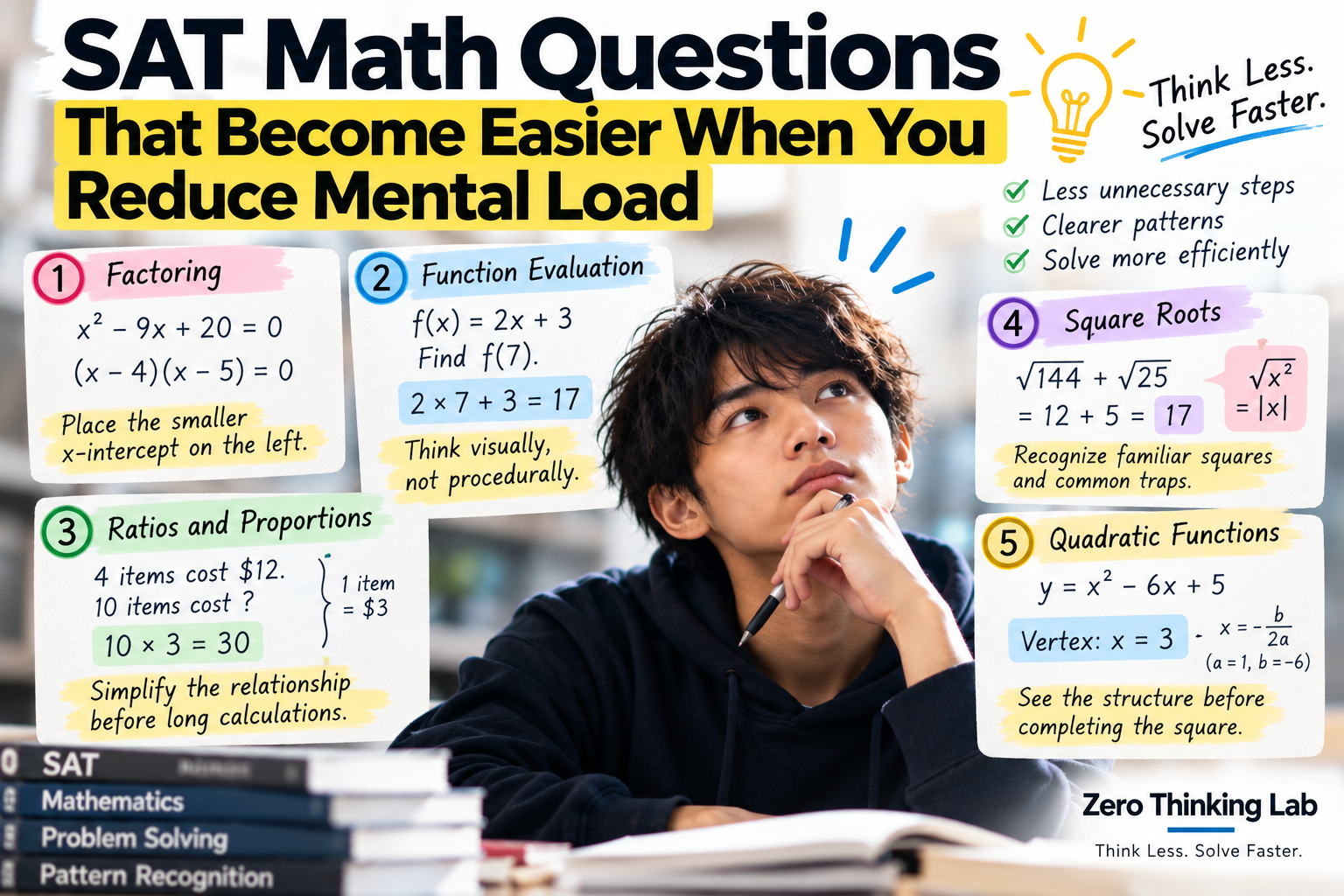
A lot of SAT Math problems feel difficult only because students calculate too much.
Mental math is often about removing unnecessary steps before they begin.
Here are five examples.
1. Factoring
x² − 9x + 20 = 0
This factors into:
(x − 4)(x − 5) = 0
One small habit I use is placing the smaller x-intercept on the left.
It makes graphing faster later and helps reduce careless mistakes.
Tiny changes in how you organize information can reduce mental load.
2. Function Evaluation
f(x) = 2x + 3
Find f(7).
Instead of thinking about substitution as a series of steps, start by seeing:
2 × 7
Then add 3:
14 + 3 = 17
SAT Math often becomes easier when the calculation feels visual instead of procedural.
3. Ratios and Proportions
Four items cost $12.
Instead of setting up a long proportion equation, simplify the relationship first.
If four items cost $12, then one item costs $3.
So ten items cost:
10 × 3 = 30
Another way to see it is to go from four items to ten items by doubling four to get eight, then adding two more.
That gives:
12 × 2 + 12 ÷ 2
= 24 + 6
= 30
The goal is not simply doing math faster.
The goal is reducing friction.
4. Square Roots
√144 + √25
Once you recognize familiar perfect squares, this becomes straightforward:
12 + 5 = 17
But square roots also create common SAT traps.
For example:
√(x²)
does not always equal x.
It equals |x|, the absolute value of x.
Recognition matters more than memorization.
5. Quadratic Functions
y = x² − 6x + 5
Many students immediately start completing the square.
But the vertex’s x-coordinate can be recognized first:
x = 3
For a quadratic function in the form y = ax² + bx + c, the vertex’s x-coordinate is −b / (2a).
Here, a = 1 and b = −6.
So:
x = −(−6) / (2 × 1) = 3
Recognizing this structure can reduce the work needed to begin solving the problem.
The Core Idea Behind Zero Thinking
These examples show how small changes in approach can make math feel lighter.
You do not need to eliminate thinking.
You need to eliminate unnecessary thinking.
The goal is to recognize useful structures, reduce unnecessary steps, and focus your attention where it matters.
Think Less. Solve Faster.

コメント