I worked through another set of SAT-style math problems today.
As I looked back at them, I noticed a pattern.
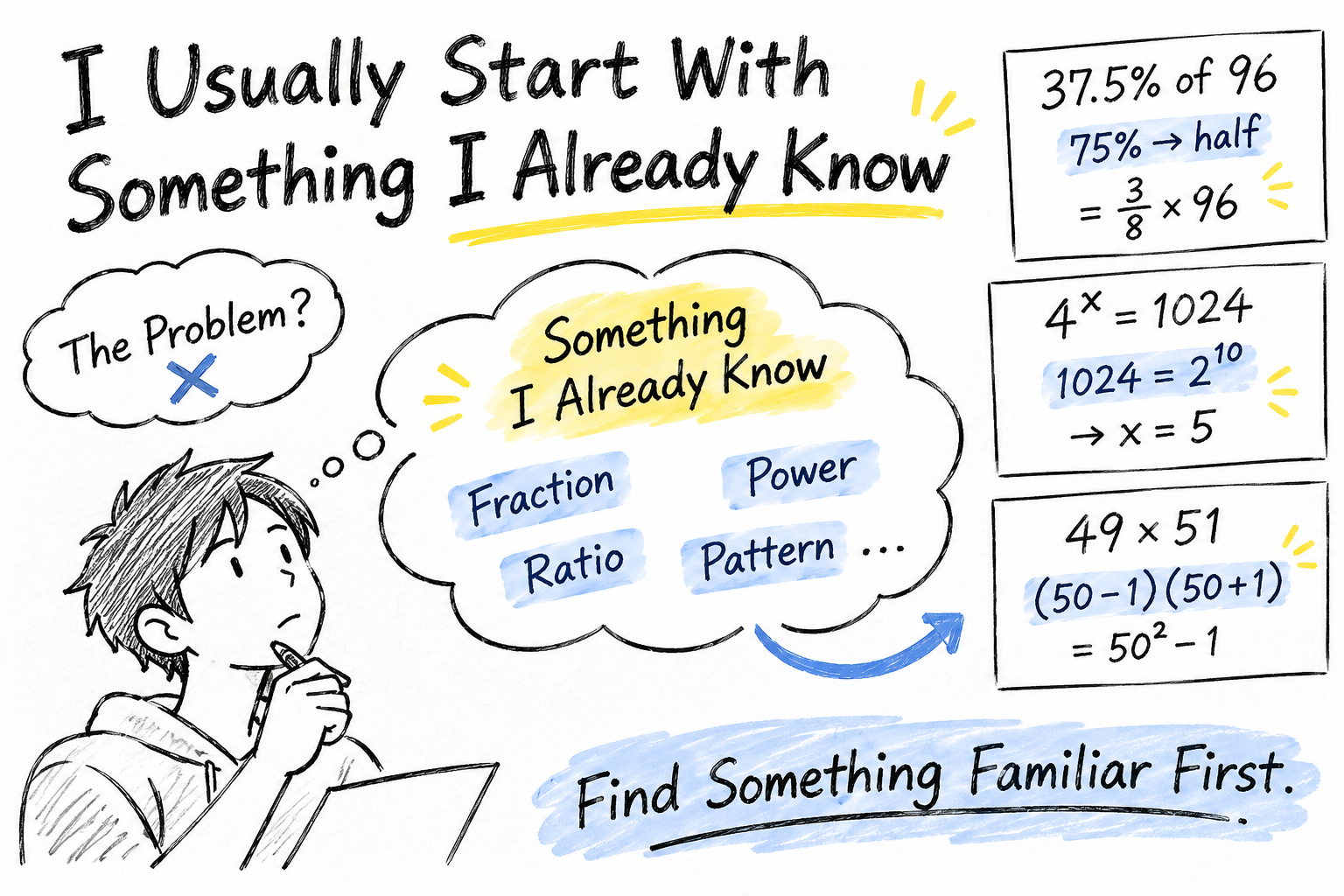
I rarely start with the problem itself.
Most of the time, I start with something I already know.
The percentage problem was a good example.
37.5% of 96 students joined a club.
I didn’t immediately think of 3/8.
What I noticed first was 75%.
That’s a familiar percentage.
Then I realized that 37.5% is simply half of 75%.
From there, 3/8 appeared naturally.
The answer wasn’t hidden inside the problem.
It was hidden inside something I already knew.
The division problem felt similar.
625 ÷ 25
I know that 100 is 25 × 4.
I know that 625 is connected to 25.
The numbers already belonged to a familiar world.
The exponent problem worked the same way.
4ˣ = 1024
When I see 1024, I rarely think of it as a random number.
I see 2¹⁰.
That’s a landmark I’ve used many times.
Once I translated everything into powers of 2, the answer became obvious.
The ratio problem was another example.
There were 18 red balls and 42 blue balls.
The first thing I noticed was 6.
Both numbers could be divided by it.
Once the numbers became 3 and 7, the percentage was easy to see.
The final multiplication problem barely felt like a calculation.
49 × 51
At this point, numbers around 50 already come with a familiar pattern.
I don’t consciously think through every step.
I simply recognize the structure.
That’s something I’ve started noticing more and more.
When a problem appears, I don’t immediately search for the answer.
I search for something familiar.
A fraction.
A power.
A ratio.
A pattern.
A landmark.
Once I find something I already know, the rest of the problem usually becomes much lighter.
Think Less. Solve Faster.
コメント