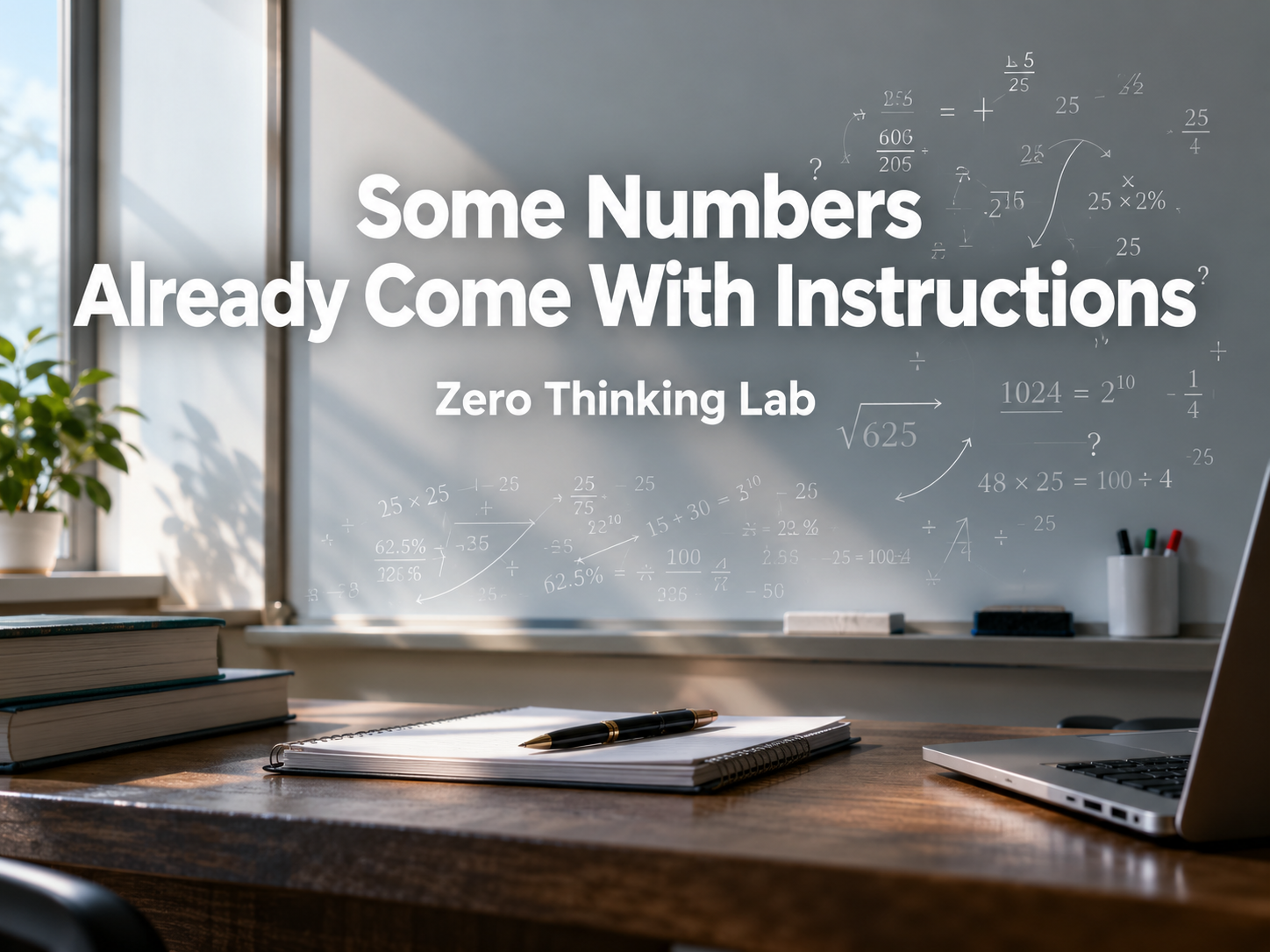
I worked through another set of SAT-style math problems today.
Something stood out to me.
Certain numbers don’t feel like numbers anymore.
They feel like instructions.
The first problem involved 62.5%.
I could have converted it directly into a fraction.
But that wasn’t the first thing I noticed.
What I saw first was 50% plus 12.5%.
Half plus one-eighth.
The percentage already came with a built-in roadmap.
The square root problem felt similar.
√625
I didn’t remember a formula.
I started looking for a familiar structure.
625 felt connected to 25, so I divided it mentally.
A moment later, I was looking at 25 × 25.
The answer appeared naturally from there.
The ratio problem worked the same way.
There were 15 boys and 30 girls.
The number 15 immediately stood out.
Both numbers could be reduced using it.
I wasn’t searching for the best reduction.
I just used the first one I noticed.
Smaller numbers are easier to understand.
That’s usually enough.
The exponent problem was built around another familiar landmark.
I rarely think of it as a random number.
I see 2¹⁰.
And once I see that, the rest of the problem becomes much simpler.
The final problem might be my favorite.
48 × 25
Whenever I see 25, I almost automatically rewrite it.
To me, 25 often means 100 ÷ 4.
That transformation makes multiplication easier.
The original problem disappears and a friendlier one takes its place.
I’ve started realizing that many numbers carry extra meaning.
25 isn’t just 25.
1024 isn’t just 1024.
62.5% isn’t just a percentage.
They’re landmarks.
Shortcuts.
Instructions.
The more of these familiar numbers I recognize, the less work I have to do.
Think Less. Solve Faster.
コメント