I worked through another set of SAT-style math problems today.
One idea kept showing up.
I don’t spend much time looking for the perfect method.
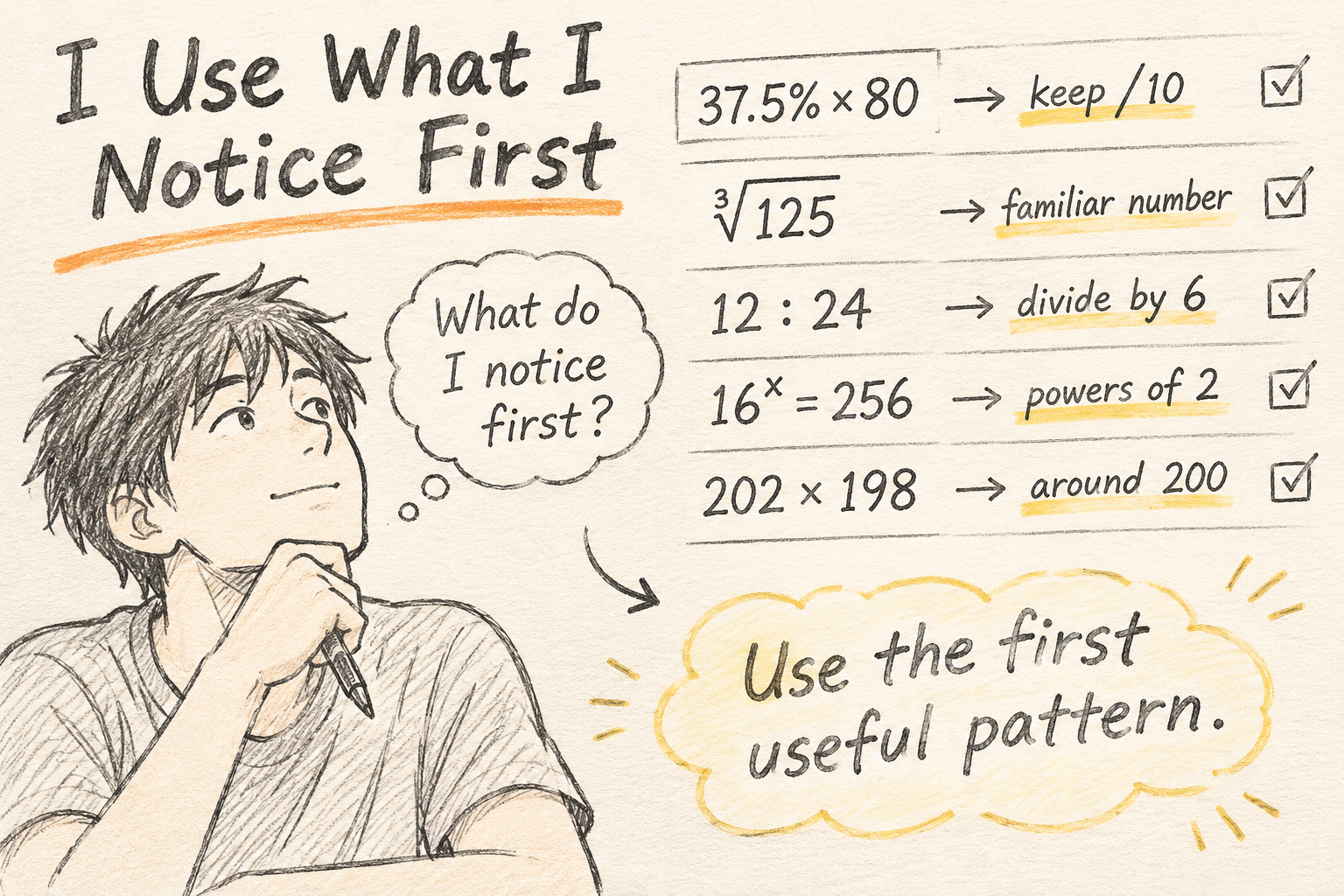
I usually use the first useful thing I notice.
The percentage problem was a good example.
37.5% × 80
There are several ways to solve it.
I could have converted 37.5% into 3/8.
That works perfectly.
But that’s not what I noticed first.
Instead, I kept the denominator as 10 because the division felt easy.
The numbers cooperated, so I followed that path.
The answer came quickly.
The cube root problem felt different.
∛125
There wasn’t really anything to solve.
125 already belongs to a number I know.
The answer appeared almost immediately because the landmark was familiar.
The ratio problem was interesting.
There were 12 boys and 24 girls.
I noticed that both numbers could be divided by 6.
Could I have divided by 12 instead?
Sure.
But I didn’t need to.
The goal wasn’t to find the best reduction.
The goal was to make the numbers smaller.
Once they became smaller, the answer became obvious.
The exponent problem followed a familiar pattern.
16ˣ = 256
I translated everything into powers of 2.
Numbers often become easier when they start speaking the same language.
The final multiplication problem reminded me of something important.
202 × 198
I could have used a difference-of-squares shortcut.
Instead, I expanded around 200.
Not because it was better.
Because it was the path I saw first.
That’s something I’ve been noticing lately.
Fast math isn’t always about finding the smartest method.
Sometimes it’s about trusting the first useful pattern that appears.
A smaller number.
A familiar fraction.
A known power.
A convenient decomposition.
The moment something looks easier, I usually follow it.
And most of the time, that’s enough.
Think Less. Solve Faster.


コメント