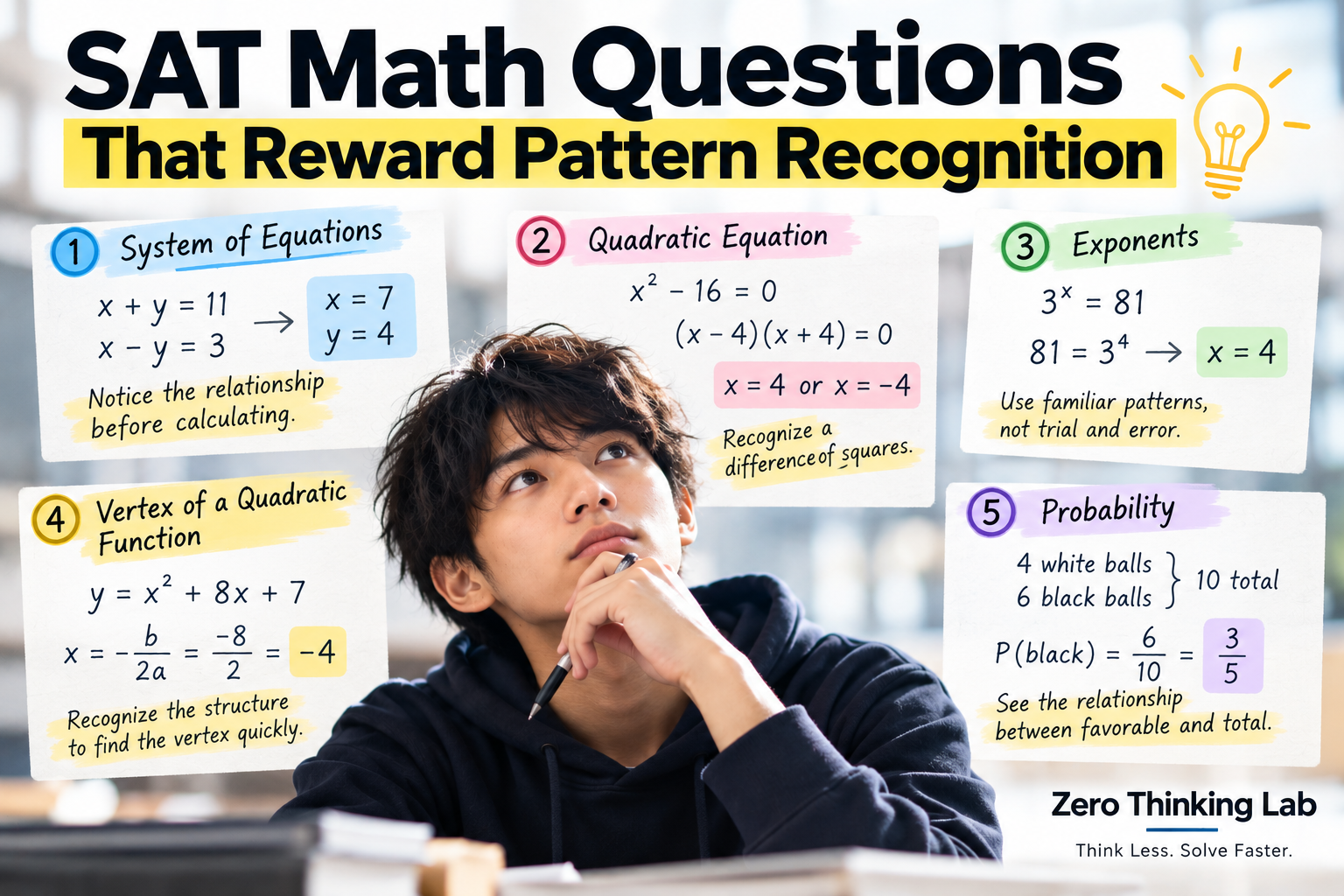
A lot of SAT Math problems become easier when you recognize patterns before calculating.
Here are five examples.
1. System of Equations
x + y = 11
x − y = 3
Instead of immediately using elimination, try noticing the relationship first.
If two numbers add up to 11 and differ by 3, they are 7 and 4.
You can recognize the answer before writing out every algebraic step.
2. Quadratic Equation
x² − 16 = 0
This equation contains a difference of squares:
x² − 4² = 0
So it can be factored as:
(x − 4)(x + 4) = 0
Therefore:
x = 4 or x = −4
Recognizing the pattern is often more efficient than expanding or calculating step by step.
3. Exponents
3ˣ = 81
Instead of testing different values of x, recognize that:
81 = 3⁴
Therefore:
x = 4
Good mental math often comes from familiarity with patterns, not simply from calculating faster.
4. Vertex of a Quadratic Function
y = x² + 8x + 7
Many students immediately start completing the square.
But there is a useful pattern to recognize first.
For a quadratic function in the form:
y = ax² + bx + c
the x-coordinate of the vertex is:
x = −b / (2a)
Here, a = 1 and b = 8.
So:
x = −8 / 2 = −4
Recognizing this structure helps you find the vertex’s x-coordinate without completing the square.
5. Probability
A bag contains:
- 4 white balls
- 6 black balls
What is the probability of drawing a black ball?
There are 10 balls in total, and 6 are black.
So:
6/10 = 3/5
Once you recognize the relationship between the favorable outcomes and the total number of outcomes, the calculation becomes straightforward.
The Real Advantage of Pattern Recognition
These examples involve different topics:
- Systems of equations
- Quadratic equations
- Exponents
- Quadratic functions
- Probability
But they share one important idea.
You do not always need to begin by calculating.
Sometimes, recognizing the structure of a problem is the most valuable first step.
That does not mean skipping necessary reasoning. It means learning to identify which steps are useful and which ones are unnecessary.
This is the core idea behind Zero Thinking.
Think Less. Solve Faster.


コメント