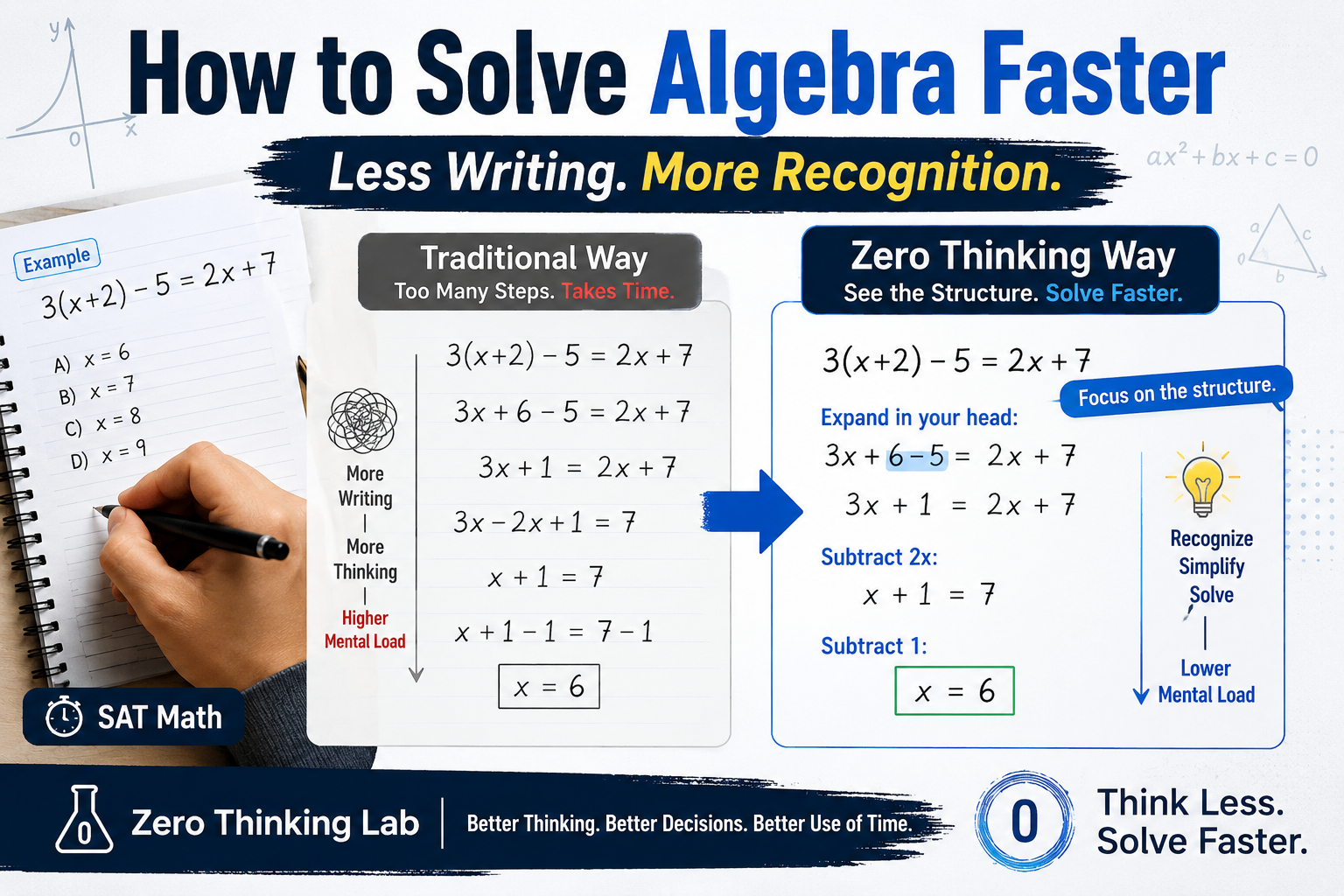
Many SAT students already know algebra.
The real problem is speed.
They hesitate too much.
They write too many unnecessary steps.
And under time pressure, that becomes a huge disadvantage.
Fast students are not necessarily smarter.
They simply process equations differently.
Instead of focusing on writing everything perfectly, they reduce mental load and recognize structure quickly.
That’s what I focus on when solving equations.
Problem 1
3(x + 4) = 2x + 19
The first thing I notice is that the coefficient of x is already very close to 1.
That means the equation is already close to:
x = number
So I’m not paying much attention to the position of the constants.
Instead, I immediately focus on the difference between:
3 × 4
and:
19
while keeping the signs consistent.
At that point, the answer is basically finished mentally.
Most students slow themselves down because they write every tiny step.
But once your brain gets used to processing equations internally, excessive writing starts to feel unnecessary.
Problem 2
5x – 8 = 2x + 13
When I look at this equation, the first thing I see is:
3x
That immediately becomes the target.
I’m not thinking about “moving terms across the equation.”
I’m thinking:
“How do I make the coefficient of x become positive 1 as quickly as possible?”
So mentally, I already see:
3x = 21
Then:
x = 7
The position of the constants is not very important to me.
Left side or right side doesn’t matter much.
The important thing is simplifying the x-term efficiently.
Problem 3
4(2x – 1) = 3x + 17
Again, the first thing I notice is:
5x
Once I distribute the equation, I already know the structure becomes:
5x = number
So I calculate the constants quickly and divide by 5 at the end.
Fast algebra is often about recognizing the structure before writing everything down.
Problem 4
x/3 + 5 = 11
Instead of multiplying both sides by 3 immediately, I subtract 5 first.
Why?
Because smaller numbers are easier to process mentally.
If I multiply too early, I create larger numbers unnecessarily:
Then I still have to subtract 15 later.
That increases mental processing and creates more opportunities for mistakes.
So I simplify the equation as much as possible before multiplying.
Efficient algebra is often about reducing unnecessary computation.
Then:
x / 3 = 6
and finally:
x = 18
Problem 5
2(x – 3) + x = 18
As soon as I distribute the equation, I immediately see that the coefficient of x becomes 3.
That means the structure is already simple.
At that point, I simply calculate the constants on the right side and finish the problem.
Again, my goal is not to make the page look beautiful.
My goal is to reduce unnecessary thinking and solve the equation as efficiently as possible.
Why This Matters for the SAT
On the SAT, most students already know the math itself.
The real challenge is processing speed under time pressure.
If you hesitate too often or write too many unnecessary steps, you lose both time and mental energy.
Fast students aren’t usually fast because their hands move faster.
They think more efficiently.
They recognize patterns earlier.
And they reduce unnecessary mental processing.
That’s what creates speed.
Recommended Practice
If you want to improve SAT algebra speed, don’t just practice solving more problems.
Practice recognizing structure quickly.
Practice reducing unnecessary writing.
Practice lowering mental load.
These are the types of resources I personally recommend for improving algebra speed and pattern recognition:
- SAT algebra practice books
- Mental math training books
- Timed equation drills
- Pattern-recognition focused exercises
The goal is not just getting the correct answer.
The goal is solving efficiently under pressure.
If You Want to Build This Skill
Many SAT books focus heavily on formulas.
But fast students also train pattern recognition and mental processing.
If you want to solve algebra faster, don’t only practice getting correct answers.
Practice reducing mental load.
Focus on:
- simplifying before expanding
- avoiding unnecessary writing
- keeping numbers mentally lightweight
- recognizing structure early
In particular, short algebra drills and timed SAT-style exercises are extremely useful for training this skill.
The goal is not doing more calculations.
The goal is thinking more efficiently.
Think Less. Solve Faster.

コメント