I noticed something interesting while working through SAT-style math problems recently.
People often assume that fast math means moving quickly and worrying less about details.
For me, it’s the opposite.
The goal isn’t to think less about important details.
The goal is to think less about unnecessary work.
A good example is percentages.
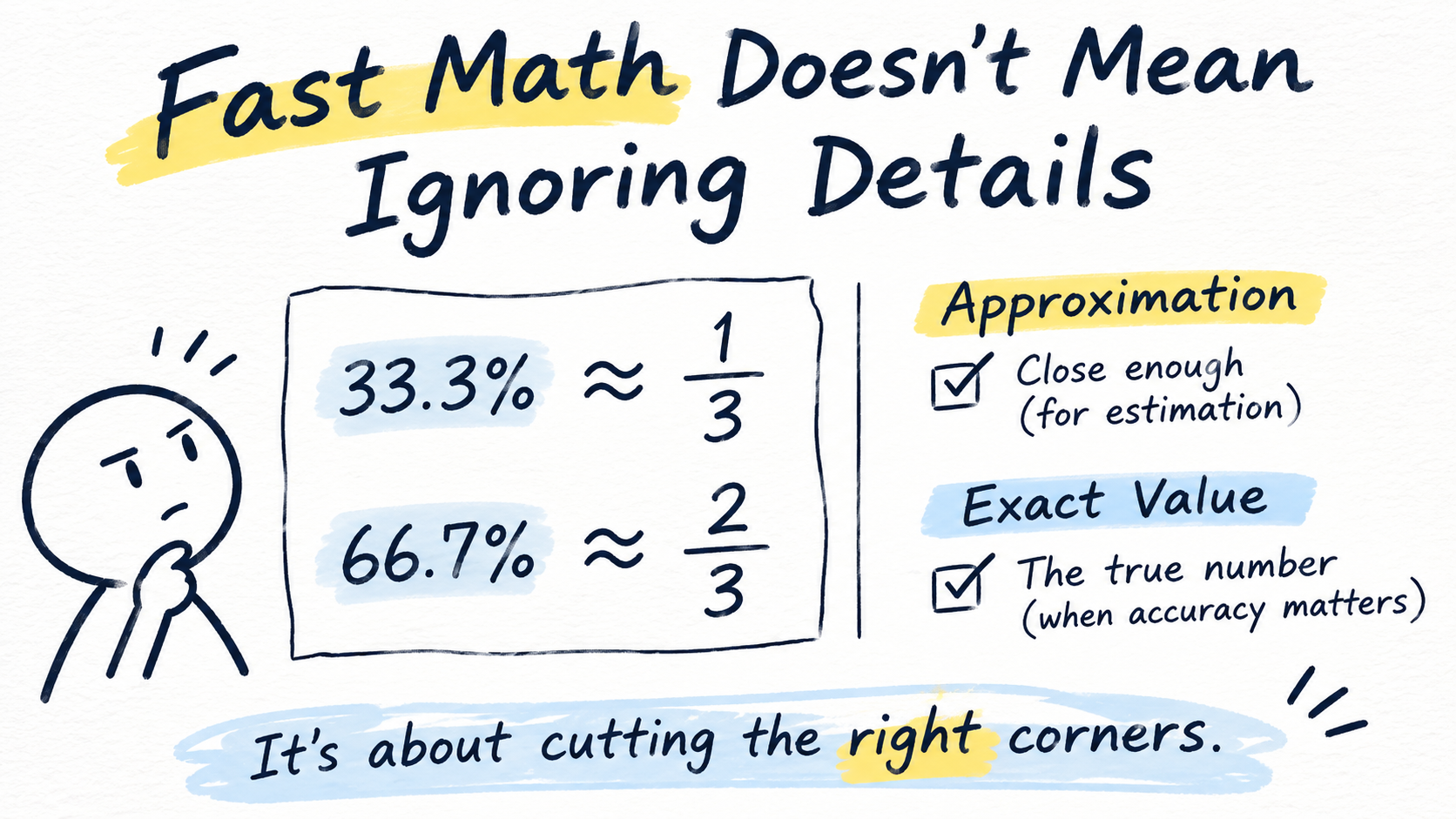
Someone might see 33.3% and immediately think of 1/3.
Most of the time, that works well enough for estimation.
But they’re not actually the same number.
1/3 is 0.333333…
33.3% is 0.333.
The difference is small, but it exists.
The same thing applies to 66.7% and 2/3.
They’re close.
They’re useful approximations.
But they aren’t identical.
That realization reminded me of something important.
Fast math isn’t sloppy math.
When I use shortcuts, I’m not ignoring accuracy.
I’m choosing which details matter.
If a problem is asking for an estimate, an approximation might be perfect.
If a problem requires an exact answer, the difference suddenly matters.
The goal isn’t to replace every number with a familiar fraction.
The goal is to recognize when that replacement is appropriate.
I’ve started noticing that many mental math skills work this way.
Good shortcuts save effort.
Bad shortcuts create mistakes.
The difference comes from understanding what the numbers actually mean.
That’s why I like familiar fractions such as 1/2, 1/4, 3/4, 1/8, and 5/8.
They’re exact.
They’re reliable.
They reduce thinking without reducing accuracy.
In other words, fast math isn’t about cutting corners.
It’s about cutting the right corners.
Think Less. Solve Faster.


コメント